Saturday, September 24, 2016

The New Normal - The Ballet, Moroccan Style


Girls at the tea tent
Richard accompanied seven lovely women to the Hippodrome D’Anfa last Thursday evening for a production of Le Voyage De Scheherazade ballet.  The Hippodrome is a horse-racing venue that is also used for concerts and other events.  A stage was set up for the dancers, with a large space for the orchestra in front.  The venue was partially covered, and a pleasant breeze blew through as we enjoyed the performance from our padded seats.  Bottled water was provided, and each woman received a bag with Sultan brand teas.  The performance was presented as a benefit for the Sanady Foundation, an association whose mission is to prevent school student dropout.

Sultan Tea for a treat
Open-air venue
Stage set-up
The story of Scheherazade is based on One Thousand and One Nights, sometimes known as The Arabian Nights.  I was very familiar with the score, as it was one of the required works I learned as a music major in college.  However, this production dance-wise was one-of-a kind.  I expected classical ballet, but instead was treated to a combination of ballet and belly dancing!  

Video clips of the performance
Some of the dancers, and the director of the orchestra
The Oriental Ballet Revolution III troupe featured 120 artists from around the world.  The costumes they wore were both colourful and enticing.  In addition, the set and lighting added to setting the mood, as we were transported through the story of seduction and love.  There was concern amongst our group that both the belly dancing and the sexy costumes might be offensive to some conservative Moroccans in the audience.  This did not appear to be the case, as there was frequent enthusiastic clapping, both for the performers and with the beat of the music. 

Colorful costumes
Professional orchestra
The symphonic suite of Rimsky-Korsakov was interpreted by the Philharmonic Orchestra of Morocco, under the direction of Pierre-Michel Durand.  The music is a combination of typical Russian-style music, with an Eastern and Oriental flavour  It was wonderful hearing this colourful music played by an 80-piece live orchestra.

Glitter fire
The ballet ended with a large-cast production number, complete with a canon firing glitter on the stage.  But our night of fun was not over; a Moroccan band, dressed in the colors of the flag appeared unexpectedly and entertained us both from the stage and later outdoors as we left.

The Moroccan Band


Short video of Moroccan musicians
This was such a treat and was extra-special because we saw it together and we saw it in Africa.  How cool is that?

Jan and Emily
Jennifer and Natasha
Susan and Carolyn

Friday, September 23, 2016

The New Normal - Language and Communication in Morocco

Parlez-vous Francais?
 هل تتحدث العربية

Numeral Systems of the World.svg


Richard and I are living in a country where very few natives speak English.  I teach in a trilingual school, where many kids come in knowing Arabic and/or French, and English ends up being their third language.  Communication can be challenging, but somehow we are managing.

Actually, we're getting by with a little help from our friends . . . Two GWA employees helped us a lot during orientation, Kaoutar and Abdeljalil.  They were super positive as we struggled through basic language classes during our first few weeks in Morocco.


Thankfully, I took French many eons ago in high school, and Richard knows significantly more than I do.  So, when Kaoutar, our awesome French teacher, began to teach us, a lot came back.  We often use our basic knowledge getting around the city in taxis, ordering food at restaurants, and just trying to be friendly with the natives with whom we have contact.


Abdeljalil helped us learn some fundamental Arabic; Moroccan Arabic is also known as Darija.  Abdeljalil was so patient as we struggled to learn just a few basic phrases.  The written language would be impossible for us to learn in a short time as the characters are so complicated.  So our teacher had to write the words out phonetically using the English alphabet.  It is very hard for me to remember words and phrases in Darija, because it is so different from English.  You really need to hear the sounds in Arabic to appreciate the language.  I'm not sure I'll ever get that guttural sound that Abdeljalil tried so hard to teach us!

All that being said, there is so much more to communication here than just language.  I tend to use a lots of hand motions, pointing, facial expressions, etc.  It makes me appreciate what the children I teach go through learning English at GWA.  They have to be totally exhausted by the end of each day. We'll keep trying and مشيئة الله, God willing, we'll figure it all out!

Our language learning curve, InshaaAllah!

Sunday, September 18, 2016

The New Normal - Moroccan cats, dogs, and other animals

Dogs are NOT man's best friend in Casablanca.  

I had heard before coming to Morocco that pets, especially dogs, are not popular here.  Although the Muslims that live here are mostly very kind, they do consider street cats and dogs "unclean."  However, I have seen the occasional dog on a leash being walked by its owner.  These dog owners are mostly American or European, although I have seen Moroccans out with their pets as well.  There is actually a dog washing place a few doors up from our apartment, and a large vet around the corner.


Mostly, though, the many cats and a few dogs in our neighborhood are strays.  They tend to be dirty (even the cats are not clean) and likely have diseases like parasites, having received no vet care.  I've seen a number of pregnant cats; there's also not much spaying and neutering going in Morocco.  In addition, it is unlikely these animals will ever be adopted; this is simply not a part of the culture in general.  

But the amazing thing is that these cats and dogs are almost all very sweet and they seem to enjoy human contact.  In that respect, I would not consider them "feral" in the strictest sense of the word.  People leave bowls of water and food out for them, and pet them.  I am not afraid when I encounter one on the street and I have come to enjoy seeing them hanging around.  They kind of keep me company as I walk the city streets.

I do feel bad that they are dirty, often hungry, and have diseases.  I love animals and I wish I could fix the situation, but I know I can't.  So, I try to look for the sweetness in them, and I pray for their welfare.

Dog resting in the sun

Dog resting in the shade

Dog resting in the shade of a truck on our street
Cat blending in around the corner
Cat with Kittens in the Marrakech medina
Cat sleeping in front of a door of a nearby candy shop


Other Animals:

Donkeys and horses can also be seen around town.  They mostly pull carts that carry produce and other items I think for poorer people.  They seem to have a docile nature and manage to remain calm even in heavy traffic.  Goats, cows, sheep, chickens, and roosters can be seen in the fields, especially in the area where GWA is located and in other locations on the outskirts of Casa.  I've seen small birds and pigeons in the city, and egrets on the school grounds and at the beach.  I have yet to see any wild animals, except birds, in Morocco.  We saw also saw some camels when we visited Marrakesh, although they were set up just for tourists.


Donkey cart in Marrakesh

Wednesday, September 14, 2016

The New Normal - Traveling to Marrakesh (on Eid) in Morocco


Marrakesh Train Station
"All aboard the train.  Wouldn't you know we're riding on the Marrakesh Express. They're taking me to Marrakesh."  

"Take the train from Casablanca going south ... traveling the train through clear Moroccan skies" was surreal and mesmerizing to me. We sat in a compartment in the front car with four other people.  I found myself staring out the window for most of the 4-hour ride. Leaving the city sights and sounds (and smells!) of Casa and traveling through the ever-changing Moroccan countryside was an amazing education.  The terrain ranged from brown and flat, to hilly and almost mountainous, with real mountains in the distance. Occasionally, swampy water areas could be seen near the tracks, and we even passed by a river or two.  Both the flat and hilly land seemed to be parceled out to landowners, often divided by prickly pear edging.  Tree orchards could be seen in the distance and near the tracks, but not much in the way of crops growing right now. The train stopped quite often as travelers down the line joined us. Sometimes the stops were in small towns, but other times they seemed to be in the middle of nowhere.  


Traveling south from Casa
Relaxing in our compartment

View of some cultivated fields
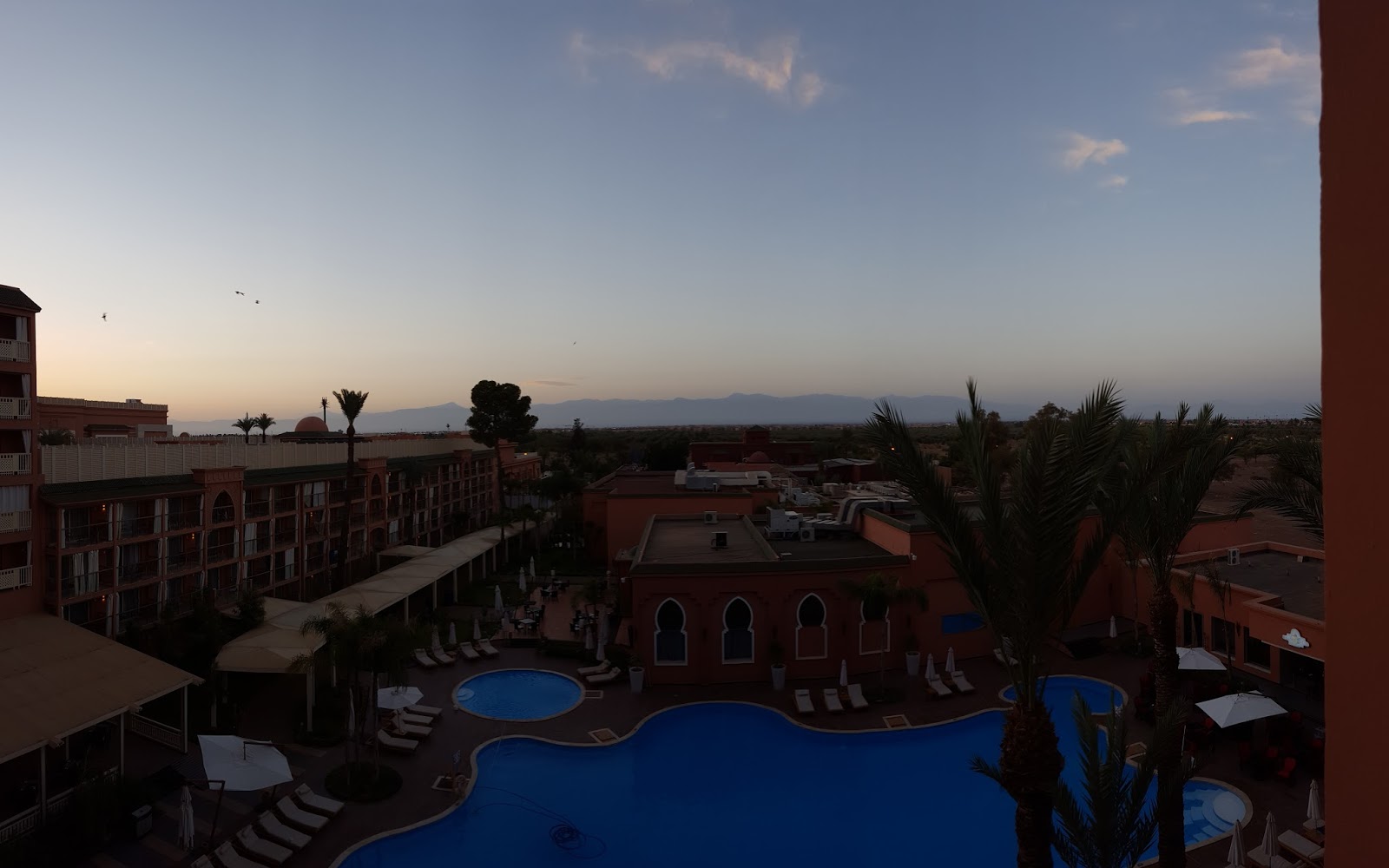
We arrived in Marrakesh, aka the red city, around 1:30 in the afternoon.  This city is quite different from Casa in many ways. The first thing that struck me was all the green...trees, plants and flowers abound, and the fact that the buildings are mostly red (as opposed to white in Casa). The air is fresh and dry, and devoid of the city smells, to which I have become accustomed.  Our lodgings, Savoy Le Grand Hotel, was nothing short of paradise. There are two huge pools, beautiful grounds, comfortable rooms and impeccable service. I would highly recommend this resort to anyone traveling to Marrakesh.  (Oh, and did I mention air-conditioning!?)


Evening view from Hotel; Atlas Mountains in the distance
Our first night we had a great tajine dinner in an open-air cafe, followed by yummy ice cream. There were misters on poles between the tables in order to put moisture into the air; it felt great.  (It's so dry here that even a wet bathing suit on a person dries amazingly quickly.)  After that, we hung out at a nearby fountain that was huge. It was basically a light show to music, with the water being shot out, up, through, etc. to go along with whatever music was playing. Its hard to describe; suffice to say it was hard to pull ourselves away from it.


However,  we finally did break away and decided to take a horse-drawn carriage ride. Our driver was friendly, speaking to us in French and a little English. We got a good feel for the medina and other places we wanted to see in the daylight. 


Ok, so Richard wasn't really driving!
Sunday was day two of our mini vacation.  We went down to the hotel's unbelievable complimentary breakfast buffet at 7AM  I have never seen such a huge spread for breakfast.  After that we headed for the medina, a very traditional Moroccan site with winding alleyways and colorful souks. The narrow passageways were crowded and the shop keepers were mostly too aggressive in my opinion.  Motor cycles were allowed, weaving in an out of the crowds. 
Take your life in your own hands!
The spice section was particularly impressive and a shop owner who spoke English very well educated us on the values of the various spices and dyes. Some were for medicinal purposes and others for cleaning, plus there were aromatic spices and of course, those for cooking. 


Spices for all purposes
Dyes
We also found an interesting shop with an owner who spend a lot of time with us. There is so much inventory in there, a variety of copper, silver, pottery, jewelry, rugs, blankets and so much more . He took us upstairs where he claimed to keep the "good stuff", putting this inventory in the context of his grandfather and the fact that there were true artisans back then.  Upstairs is where we found and bought two hand-woven Berber blankets to use this winter. 


Narrow stairway to second floor "The Good Stuff"
Room after room of inventory
Later, we toured the Bahia Palace, which is also located in the medina. It was built in the 19th century by grand viziers to the Alaouite sultans. Here we saw beautiful workmanship including intricate zellige floors, detailed painted cedar ceilings, impressive wooden doors and carved stucco. The grounds included pretty gardens and courtyards.  We were allowed to tour only a small part of the castle; it is officially part of the Royal Palace and covers 20 acres and has 150 rooms.


Intricate carving 
Colorful Tiles


Lush vegetation


We almost were able to leave medina without having to deal with the snake charmers. But, alas, we were accosted as we were looking for a taxi. I'm not big on snakes, but Richard actually ended up with one around his neck. 300 MAD later we escaped in a cab and went back to the resort. 


Transporting Sheep for Eid
On Monday, the official start of Eid finally arrived.  Eid al-Adha (the Feast of the Sacrifice) is a major Islamic holiday. (This is why we had vacation from school from Monday through Wednesday.)  The exact dates of Eid are determined by the lunar calendar and it is celebrated throughout the Muslim world. Ibrahims's sacrifice is commemorated by ritual sacrifice of sheep. Throughout the days before Eid we saw sheep being transported in every kind of vehicle imaginable. The king kicks it off by being the first to sacrifice a sheep, then everyone follows suit. Every part of the sheep is eaten, with a portion being given to the poor.  


Rather than sacrificing a sheep, we started our Eid with a visit to the Marjorelle Gardens. This Moorish villa and gardens was built in the 1920's and 30's by Jacques Marjorelle, a French orientalist painter.  Years later, the house was bought by Yves Saint Laurent, who preserved the villa and gardens.  After the death of Saint Laurent in 2008, his partner Pierre Berge donated the jardin to a foundation set up in both of their names.  There is a memorial to the French fashion designer on site.  


The gardens are spectacular and like nothing Richard and I had ever seen before. The foliage is dense and I had to remove my sunglasses to see the vegetation clearly.  The bamboo is very tall, as are many of the varieties of cactus.  Trellised vines abound and there are multiple types of plants and trees.  The brightly-colored pots and multiple reflecting pools add to the beauty and peacefulness of the place. We also enjoyed looking at the artwork of Saint Laurent in the "Love Gallery"; he created these collage "love posters" and sent them as New Years greetings to his friends and clients of his fashion house. 


Koi and coins, Fish and Wish! 


"Love" Gallery


Colored Pots
Bamboo, new and old
   
Beautiful Trellis


Memorial to Yves Saint Laurent
Awe, isn't he cute?


Pond
For lunch, the hotel offered a gigantic Eid buffet. I even ate lamb to celebrate along with the Moroccans.  
Tajine, a very small part of the buffet
Eid Watermelon
Hanging out poolside for the balance of the afternoon and Tuesday morning rounded out our first Moroccan holiday.  


Sunset from the rear of the Savoy Hotel


Postscripts - A friend's view of Eid:
http://www.huffingtonpost.com/desiree-michael/hitchcockian-view-into-mo_b_11991936.html

Another co-worker's perspective of Eid (a comparison to Christmas):

http://dngrudda.blogspot.com/2014/10/just-little-different.html

Addendum:
Below are Berber blankets we bought at the medina in Marrakesh, "The Good Stuff".  We really liked the owner of this shop; highly recommended with LOTS of stuff to buy.


When we asked about how to wash the blankets, the man replied "you never need to wash them, just hang them out to air dry."  Interesting.

Addendum 2:  If you travel on a holiday weekend, get your train tickets ahead of time.  Also, travel first class, which is a compartment with 6 passengers.  It's not much more money and is well worth it!